
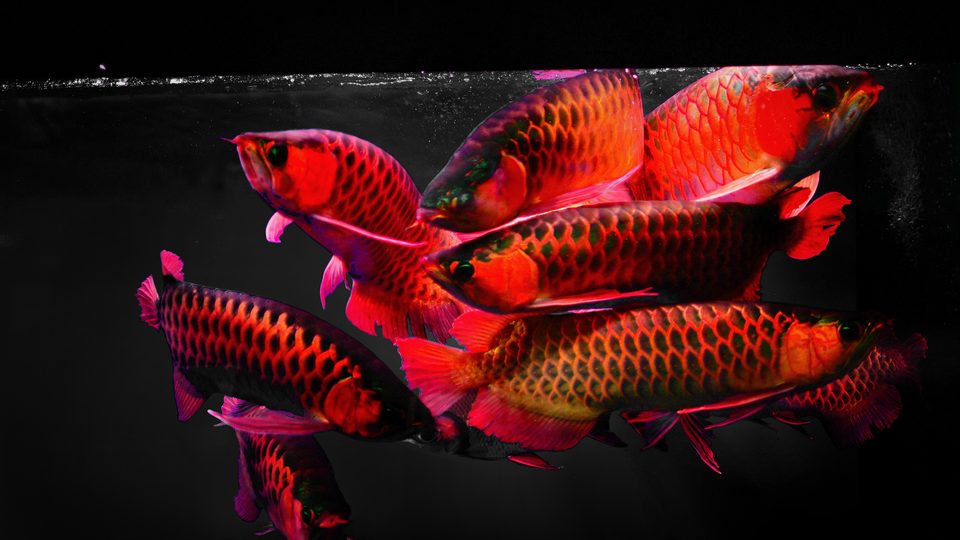
The tank: size first, everything else second
An Asian arowana is not a big fish that tolerates a small tank while it grows. It is a surface-swimming predator that reaches 60–90 cm and lives well past twenty years, and the tank decides almost everything about how it develops — body shape, finnage, temperament.
How much tank depends on the variety. At the farm we recommend at least 4 ft × 2 ft for a Crossback, and 5 ft × 2.5 ft for a Blood Red — the larger body needs the extra run to develop to its full potential — and more is always better. Length and width matter far more than height: the fish lives in the top third of the water and needs room to turn without folding. A cramped tank is the quiet cause behind bent barbels, gill curl and a fish that never carries itself well.
- A tight, weighted cover is not optional. Arowana are powerful jumpers, and a startled fish will find any gap. More keepers lose fish to the floor than to disease.
- Keep the layout simple. Bare or lightly furnished tanks are easier to keep clean, and sharp hardscape scratches scales and tears fins on a fish this size.
- Filtration should be generous — a heavy carnivore produces heavy waste. A sump, as we build into our custom tanks, keeps equipment out of the swimming space.
Water: stability beats perfection
Arowana are tropical blackwater fish. The targets are not exotic: 26–30 °C, pH somewhere between 6.5 and 7.5, ammonia and nitrite at zero, nitrate kept low with regular changes. What matters more than any single number is that the water does not swing.
Change 25–30% weekly, dechlorinate properly, and match the temperature of new water to the tank. A large, sudden change stresses the fish more than slightly old water does. This is also why we climatise every fish before it leaves the farm — moving a fish between two stable but different waters is a process, not a bucket.
Feeding: variety, restraint, and clean sources
Arowana are carnivores. Build the diet around a good surface pellet made for arowana, and rotate real food alongside it: thawed market prawn (shell off for smaller fish) and frozen fish. Keep the diet lean — fatty food shows up later as a fish that carries itself poorly.
Feed juveniles two to three times a day, and adults once a day — many keepers rest their adult fish one day a week, and so do we. Everything should be eaten within a couple of minutes; food that sinks and rots is a water problem you created at feeding time.
Be careful with live feeder fish. They are the classic route for parasites and bacterial infection into an otherwise clean tank. If you must use them, quarantine them first — or skip them entirely. Nothing in an arowana’s diet requires live fish.
Tankmates: alone is a feature
The safest arowana tank holds one arowana and nothing else. This is not a compromise — a single fish grows calmer, feeds better and shows better colour without competition.
If you want company, choose robust fish of similar size that live in a different layer of the tank: freshwater stingrays and large catfish on the bottom, datnoids mid-water. Never keep two or three arowana together in an ordinary tank — they are territorial, and the smaller fish will be harassed relentlessly. Groups only work at six or more fish in very large water, which is farm territory, not living-room territory.
The problems we actually see
Most arowana ailments walk through our grooming and hospitalisation service in one of four forms, and most trace back to the tank or the feeding, not to bad luck.
- Drop eye — one or both eyes angling downward. Strongly associated with fatty diets and with fish that spend their lives looking down at food and reflections. Feed lean, feed at the surface, and consider covering the tank bottom’s reflections early.
- Gill curl — the gill cover’s soft edge lifting or curling, classically linked to cramped tanks and declining water quality. Caught early, more space and clean water can arrest it; advanced cases need intervention.
- Jump injuries — torn fins, lost scales, or worse. Almost always a cover problem or a fright problem. Scales regrow and fins mend in clean water; the floor forgives nothing.
- Refusing food — usually stress: a move, a water swing, a new tankmate, a season change. A healthy arowana can fast for days without harm. Fix the water first, offer variety second, and resist the urge to keep dropping food into a tank that is telling you no.
Choosing a fish that will not break your heart
Care starts before the fish. Buy from a CITES-registered farm where you can see the parent stock, and where every fish is microchipped and matched against its papers. Ask how the fish has been fed, and have it climatised to water like yours before it travels — both are standard practice here.
Then be honest about your tank. We ask every buyer about their water and their space before we talk about fish at all, because the right arowana is the one that suits the home it is going to — not the one that looked best under shop lights.
Quick questions
- How long do arowana live?
- Well over twenty years with good care. An arowana is a decades-long commitment, closer to a dog than to most aquarium fish.
- What size tank does an arowana need?
- Plan for the adult from day one, by variety: at least 4 ft × 2 ft (about 120 × 60 cm) for a Crossback, and 5 ft × 2.5 ft (about 150 × 75 cm) for a Blood Red — always with a tight cover, and bigger is always better.
- Can a beginner keep an arowana?
- A careful beginner with the right tank, patience and a good source can. Most failures come from small tanks, unstable water and casual feeding — all avoidable, none of them about experience.
- Why has my arowana stopped eating?
- Usually stress rather than sickness — a recent move, a water change too far, a new neighbour. Check the water, offer something different, and give it days, not hours. If it persists alongside other signs, ask for help early.