
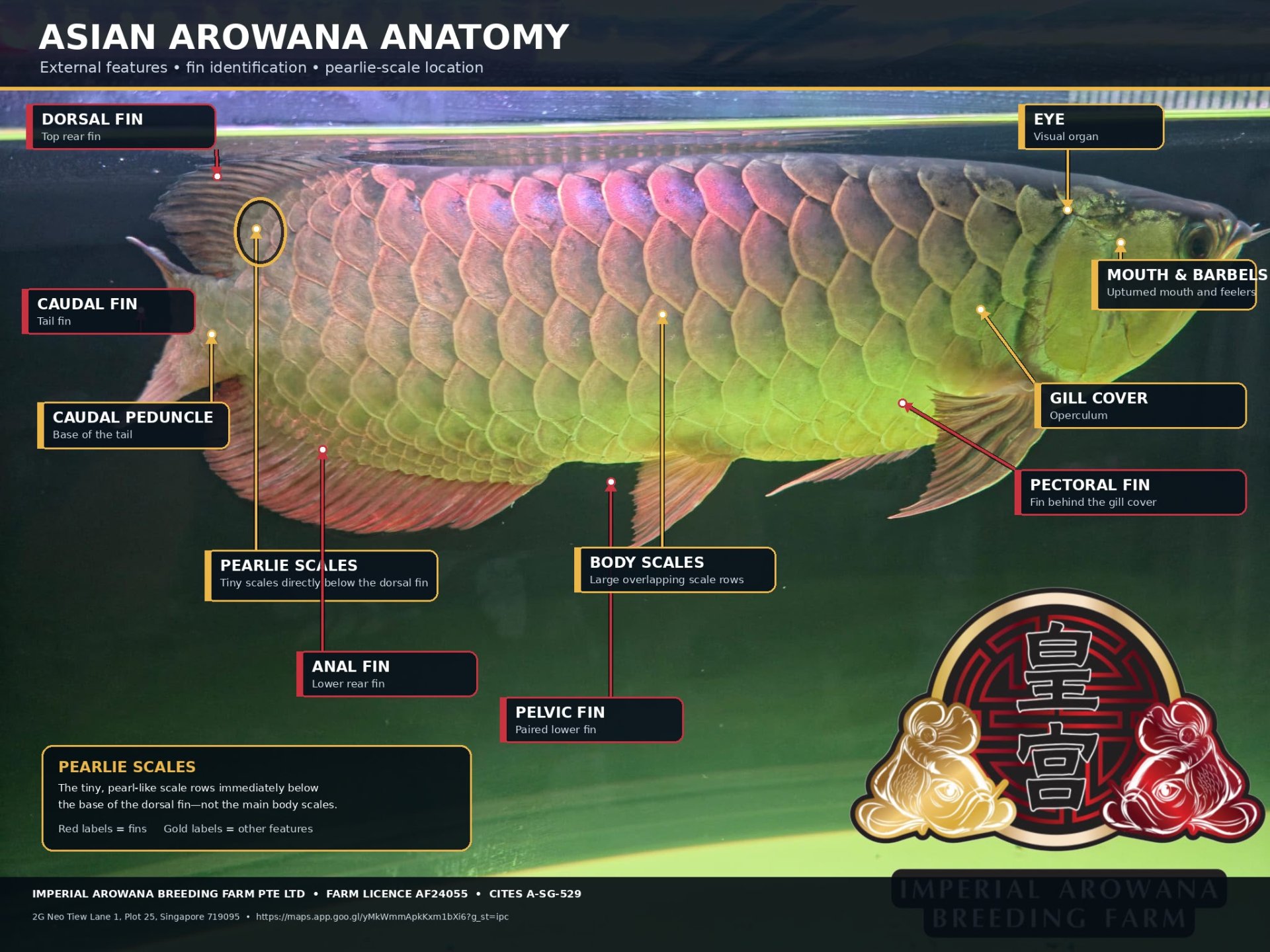
We prepared this educational poster using a real Arowana as a reference to identify its main external features, including the five important types of fins:
* Dorsal fin — located along the upper rear of the fish and helps with stability.
* Caudal fin — the tail fin that provides propulsion.
* Anal fin — the large lower rear fin that supports balance and stability.
* Pelvic fins — the smaller paired fins along the lower middle section.
* Pectoral fins — positioned behind the gill covers and used for steering, braking and controlling movement.
The poster also identifies the eye, mouth, barbels, gill cover, body scales and caudal peduncle, which is the narrow section connecting the body to the tail.
One feature that is frequently misunderstood is the pearlie scales.
Pearlie scales are the tiny scales located immediately beneath the base of the dorsal fin. They are not the large main body scales, and they are not the small scales above the anal fin.
When assessing a Crossback Arowana, breeders and experienced hobbyists observe how complete, developed and neatly arranged these tiny pearlie scales are. However, pearlie development alone does not determine the overall quality of a fish.
A proper assessment must consider the complete fish—body proportion, scale alignment, base colour, shine and lustre, finnage, tail shape, swimming posture, stability and, most importantly, its genetics.
At Imperial Arowana, our selective-breeding programme is supported by DNA profiling. We study and match suitable pedigree lines to minimise DNA dilution and produce offspring with more consistent and predictable characteristics.
Understanding the correct terminology allows hobbyists to make better comparisons and appreciate the different qualities of an Asian Arowana. We hope this poster provides a clear and useful reference for both new and experienced keepers.
Imperial Arowana Breeding Farm Pte Ltd
Farm Licence: AF24055
CITES Registration: A-SG-529