When we talk about aquarium maintenance, most hobbyists understand the importance of regular water changes, cleaning filtration systems and removing fish waste from the bottom of their tanks.
But here’s something we would like fellow hobbyists to think about.
How many of us actually pay attention to the surface of the water when performing a water change?
At Imperial Arowana, we believe that understanding what happens inside our aquarium is just as important as knowing how much water to change.
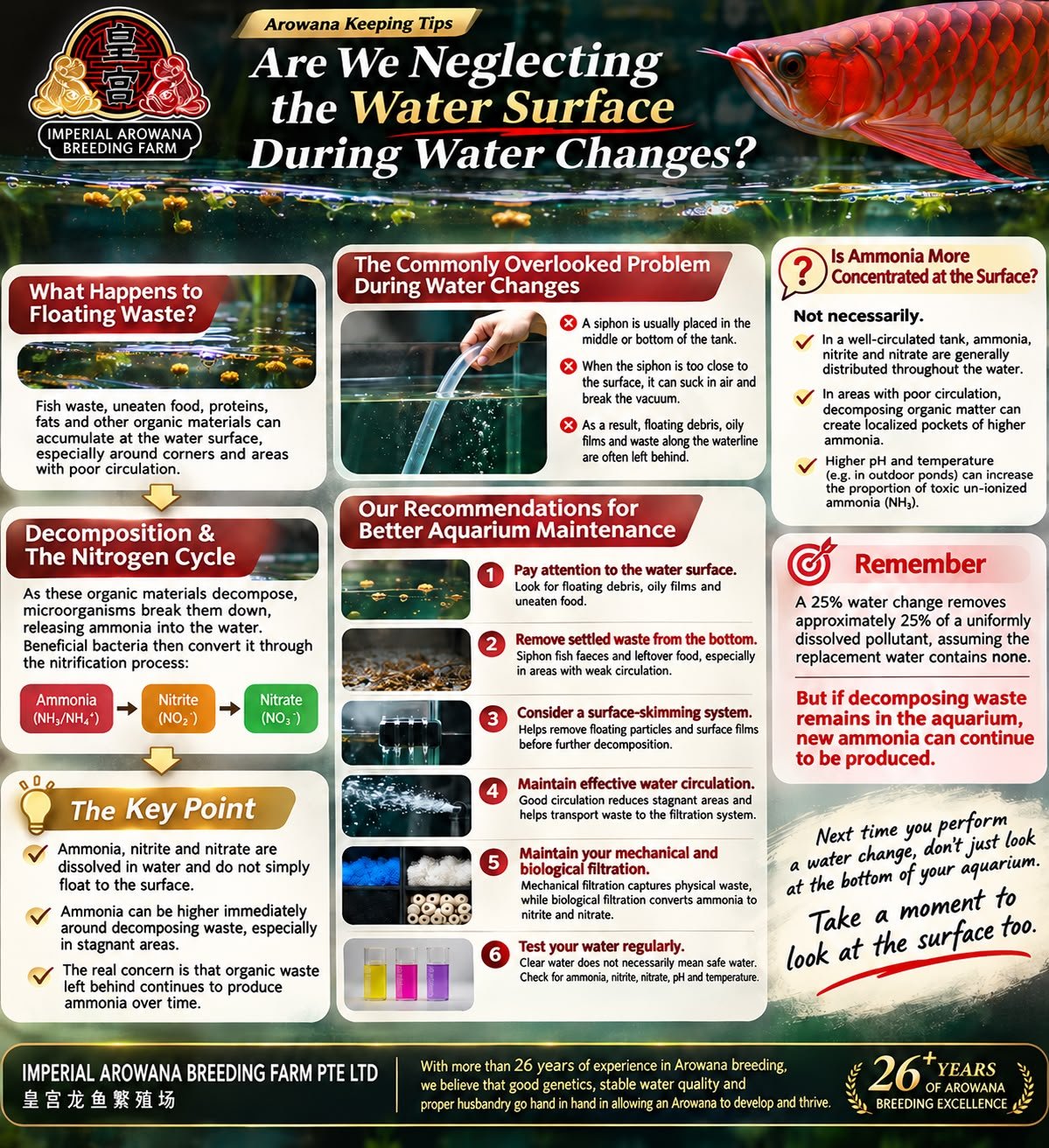
🧪 WHAT HAPPENS TO FLOATING WASTE AND UNEATEN FOOD?
Fish waste, uneaten food, proteins, fats and other organic particles can accumulate at the water surface, especially around corners and areas with poor circulation.
As these organic materials begin to decompose, microorganisms break them down, releasing ammonia into the surrounding water.
In a properly functioning biological filtration system, beneficial bacteria subsequently convert:
Ammonia (NH₃/NH₄⁺) → Nitrite (NO₂⁻) → Nitrate (NO₃⁻)
Ammonia and nitrite are particularly dangerous to fish, while nitrate can accumulate over time and should also be managed.
However, there is an important scientific distinction.
Ammonia, nitrite and nitrate are dissolved in water. They do not simply float to the surface because they are lighter.
Although ammonia concentrations may initially be elevated immediately around decomposing organic matter, water circulation gradually distributes these dissolved substances throughout the aquarium.
The real concern is not that ammonia floats. It is that organic waste left behind continues to contribute to ammonia production.
💧 THE COMMONLY OVERLOOKED PROBLEM DURING WATER CHANGES
Most hobbyists use a hose or siphon pipe when changing aquarium water.
The pipe is generally positioned near the bottom or somewhere within the water column.
Why?
Because when the siphon approaches the surface, it can easily suck in air, breaking the vacuum and interrupting the draining process.
Consequently, many hobbyists naturally avoid bringing the siphon too close to the surface.
But this also means that floating organic debris, protein films and waste trapped along the waterline may remain untouched.
Imagine performing a 20–25% water change while leaving behind the organic materials that continue to decompose.
We may have removed some dissolved pollutants through dilution, but we have not necessarily removed their ongoing sources.
Changing water and removing waste are two related but different aspects of aquarium maintenance.
🔬 DOES THIS MEAN AMMONIA IS MORE CONCENTRATED AT THE SURFACE?
Not necessarily.
In a well-circulated aquarium, dissolved ammonia, nitrite and nitrate are generally distributed throughout the water.
However, in areas with poor circulation, decomposing organic matter can create localized pockets of elevated ammonia before it disperses.
Another factor worth understanding is pH and temperature.
At higher pH and temperatures, a greater proportion of total ammonia exists as toxic un-ionized ammonia (NH₃).
This is particularly important in outdoor ponds, where sunlight, algae and aquatic plants can influence pH and temperature throughout the day.
Therefore, effective water management involves more than simply measuring how much water has been replaced.
🐉 OUR RECOMMENDATIONS FOR BETTER AQUARIUM MAINTENANCE
At Imperial Arowana, we encourage hobbyists to look at the aquarium as an entire ecosystem.
1. Pay attention to the water surface.
Look for floating debris, oily films, uneaten food and organic matter accumulating around corners.
2. Remove settled waste from the bottom.
Fish faeces and leftover food commonly settle at the bottom, particularly in areas with weak circulation.
3. Consider a surface-skimming system.
A properly designed surface skimmer can help remove floating particles and surface films, allowing mechanical filtration to capture them before further decomposition. The collected waste must still be removed through filter maintenance.
4. Maintain effective water circulation.
Good circulation reduces stagnant areas and helps transport suspended waste towards mechanical filtration.
5. Maintain your mechanical and biological filtration.
Mechanical filtration captures physical waste, while biological filtration supports the bacteria responsible for converting ammonia into nitrite and nitrate.
Both play different but equally important roles.
6. Understand that clear water does not necessarily mean healthy water.
Ammonia and nitrite can be present even when aquarium water appears crystal clear. Testing water parameters remains important.
❤️ OUR PHILOSOPHY AT IMPERIAL AROWANA
With more than 26 years of experience in Arowana breeding, we have learned that successful fish keeping is not about following maintenance routines blindly.
It is about understanding why we perform them.
Whether we are managing our breeding ponds, grooming tanks or advising customers on their home aquariums, we believe prevention is always better than dealing with problems after they occur.
Our breeding programme is built upon selective breeding, DNA profiling, genetics-backed pedigree management, traceability and sustainable captive breeding practices.
But good genetics alone are never enough.
Proper husbandry, stable water parameters and responsible aquarium maintenance are equally important in allowing an Arowana to develop and thrive.
Remember: A 25% water change removes approximately 25% of a uniformly dissolved pollutant, assuming the replacement water contains none. But if decomposing waste remains in the aquarium, new ammonia can continue to be produced.
The next time you perform a water change, don’t just look at the bottom of your aquarium.
Take a moment to look at the surface too.
Sometimes, the smallest details in fish keeping make the biggest difference.