
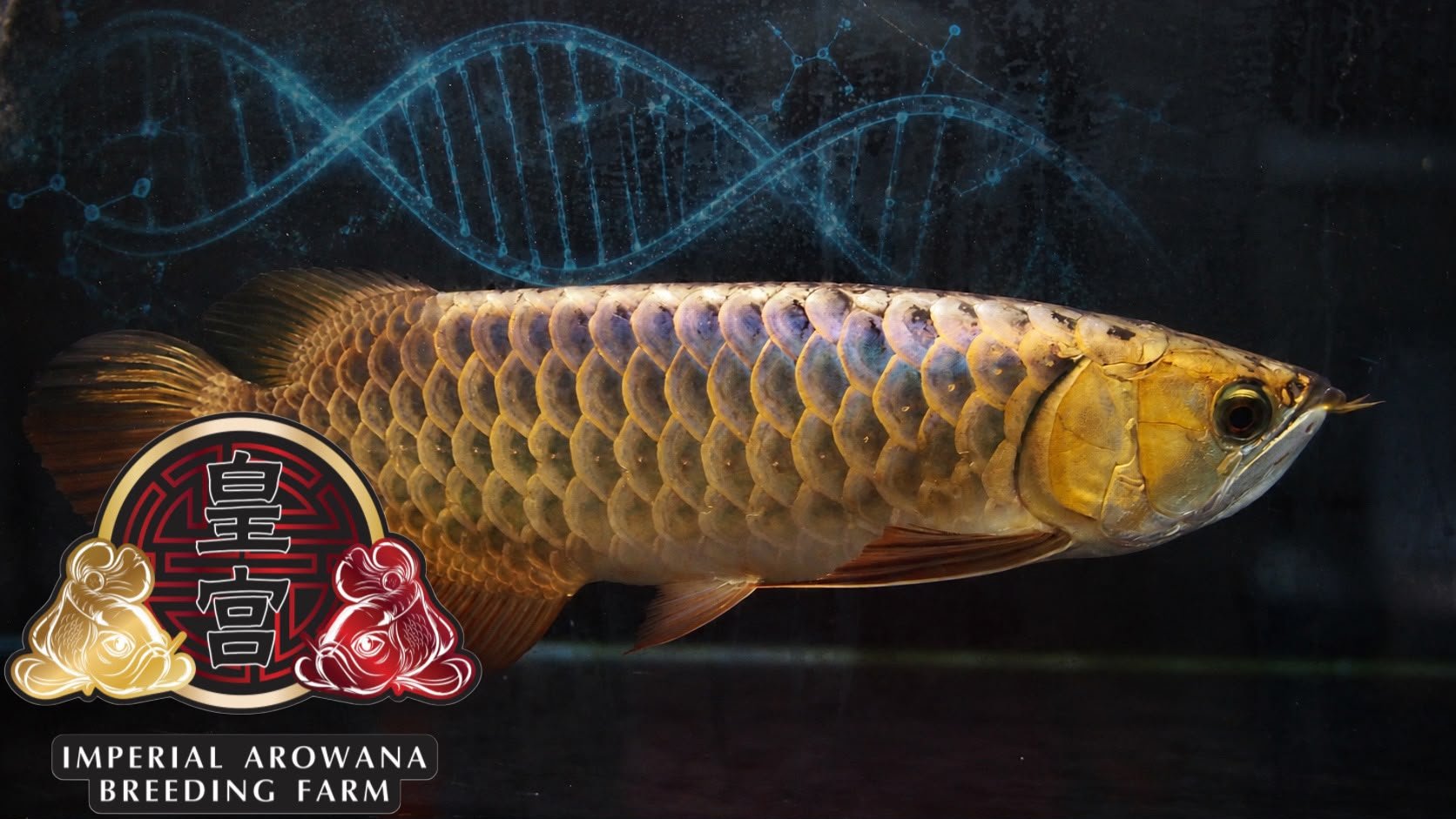
At Imperial Arowana Breeding Farm, selective breeding is not simply about placing an attractive male and female together. It is a long-term breeding programme supported by DNA profiling, documented parentage, brood records and years of observing how each family develops.
What does DNA profiling do?
DNA profiling examines selected genetic markers within a fish’s genome. In aquaculture, these markers can be used to verify parentage, distinguish family lines, assess genetic relationships and monitor genetic diversity.
Research has shown that DNA-marker systems—including microsatellites—can be used to study genetic diversity specifically in Asian Arowana. In wider aquaculture breeding programmes, genetic markers have also made highly accurate parentage assignment possible. This allows breeders to identify which parents produced a particular batch instead of depending only on appearance or assumptions. Asian Arowana genetic-diversity study, aquaculture parentage-assignment review
However, DNA profiling does not directly guarantee that every fry will develop the same colour, body shape or finnage. It is a scientific management tool. Its value comes from combining genetic information with actual breeding records and the observed results of previous generations.
From DNA information to selective breeding
Our process evaluates both genotype and phenotype.
The genotype is the genetic information carried by the fish. The phenotype is what we can observe—body structure, scale development, colour base, shine, pearlies, finnage, growth pattern, health and other characteristics.
We therefore study:
* The DNA profiles and genetic relationship of potential brooders
* Verified parentage and pedigree history
* Results previously produced by the same parents or family line
* Consistency among siblings
* Health, structure, colour and development over time
* The level of genetic diversity within the breeding population
Brooders are then matched according to the characteristics we intend to strengthen while avoiding pairings that may create excessive genetic distance or unnecessary inbreeding.
This is selective breeding backed by records and science—not breeding by appearance alone.
Understanding “DNA dilution”
“DNA dilution” is commonly used by breeders to describe the gradual reduction or reshuffling of a desired family’s genetic influence over successive generations.
Scientifically, DNA is not literally diluted like a liquid. Every fry receives approximately half of its nuclear DNA from its father and half from its mother. During reproduction, recombination reshuffles those genes. This means that even full siblings will inherit different combinations, and no responsible breeder can make every fry genetically or visually identical.
Natural genetic variation cannot—and should not—be completely prevented. It is necessary for the long-term health, adaptability and sustainability of a breeding population. Excessively narrowing a line can increase inbreeding and potentially reduce fertility, survival or overall robustness.
What we can do is control the direction of each generation.
At Imperial Arowana, we compare the DNA profiles, pedigree records and proven performance of our brooders. Where the available genetic-marker data supports it, our internal pairing objective is to select brooders that fall around an 80th-percentile level of suitability against the characteristics and reference line we are preserving.
This does not mean that two fish “share 80% of their DNA,” nor does it promise that 80% of every fry will look identical. All members of the same species already share most of their genome. The 80th-percentile figure is better understood as an internal ranking target: the proposed pairing performs as well as or better than approximately 80% of the suitable candidates assessed under our chosen genetic and pedigree criteria.
It helps us control the rate at which desired genetic characteristics are reshuffled while still maintaining sufficient diversity within the population.
Why pedigree records matter
DNA data becomes much more powerful when it is connected to a properly documented pedigree.
At our farm, batches are kept traceable to their brood and parents. We record which pair produced each batch and continue observing how the offspring develop. Over time, this allows us to identify brooders and family lines that repeatedly produce desirable characteristics.
When a particular pairing consistently produces offspring with strong structure, proper scale development, good finnage and the expected colour potential, that result becomes part of the breeding record. Future selections can then be made from evidence rather than memory or guesswork.
Genetic selection in aquaculture can improve the accuracy of breeding decisions, but its effectiveness depends on properly collected performance and pedigree information. It also needs careful management to balance genetic progress with genetic diversity. Genomic selection in aquaculture, FAO aquaculture genetics guidance
Consistency does not mean identical
A quality pedigree batch should show a recognisable family direction, but every fry remains an individual.
Environment, nutrition, water conditions, health, stress and grooming can influence how inherited potential is expressed. Some traits are also controlled by many genes rather than a single gene. For this reason, even a carefully planned pairing may produce exceptional individuals, expected-grade offspring and a smaller number that fall outside the desired standard.
Our objective is not to eliminate nature’s variation. It is to reduce uncertainty and increase the probability of producing fry that develop according to the intended pedigree.
The larger the number of generations we document, profile and evaluate, the better we understand what a line can genuinely produce.
Quality begins before the fry is born
A beautiful juvenile can be selected by eye, but a dependable breeding programme must look much further back—to its parents, grandparents, siblings and previous batches.
DNA profiling gives us traceability and measurable genetic information. Pedigree records show us where the fish came from. Long-term observation reveals what its family actually produces. Selective breeding brings all three together.
There can never be a 100% guarantee that every fry will develop identically. Genetics does not work like photocopying. What responsible breeding can deliver is a much higher level of predictability, consistency and accountability.
At Imperial Arowana, we do not leave the future of our fish entirely to chance.
We study the bloodline.
We verify the parentage.
We preserve genetic diversity.
We control genetic dilution through carefully planned pairings.
We select each generation to improve the next.
That is how quality pedigree fry are produced—not through guesswork, but through science, records, experience and time.